The 2026 Digital Rights Asia-Pacific Assembly in Manila, Philippines, saw over 600 attendees gather to co-create shared infrastructure and build collective resources towards the sustainability of the region’s digital rights movement. On Day 2 of DRAPAC26, Foundation for Media Alternatives Legal and Policy Advisor Jamael Jacob closed out the day with a speech advocating for a resistant – instead of a resilient – digital future.
Drawing inspiration from the song “Rage” by the Filipino band The Jerks, Jacob argued that a digital rights movement that is content with surviving – with resilience – will not transform the conditions that make survival necessary. Rather, it is resistance – and the refusal it gives rise to – that creates the conditions for lasting change.
Read Jacob’s full speech below.
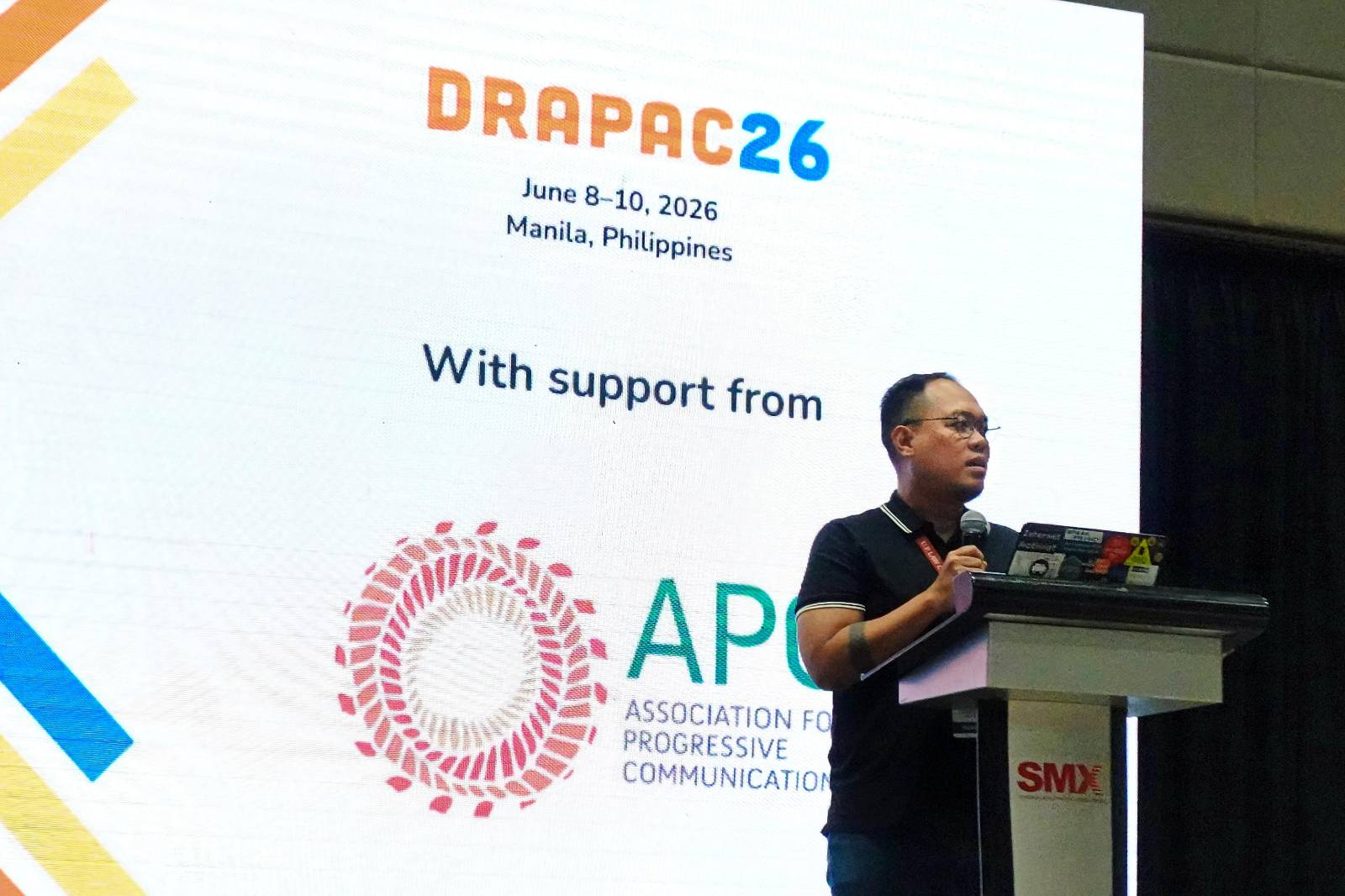
A Resistant Digital Future
Good afternoon/evening everyone!
The theme for this year is “Resilient Digital Futures: Co-creating Collective Resources Across Movements”. And during these 3 days, we’ve all been invited to reflect on what it means to build a digital future grounded in accountability, democratic participation, and collective care. Has anyone done it already?
I have. I did the assignment. I followed the instructions. I reflected.
I tried to take in as many insights and sentiments as possible from the different sessions I joined, from my conversations with Phet, Lisa, Javier, and a few others, and from my personal musings while looking back at my own time with civil society work—all the way back to the moment I fully committed to this vocation.
My realization? I’m not a big fan of resilience.
Yesterday, Phet and Dhyta spoke about how, as a quality, it has already been appropriated and abused by so many for a variety of reasons—to bury incompetence, to excuse negligence, to evade accountability, to undermine any sincere desire for change, and many other shortcomings.
Governments praise their constituents for their resilience, to gloss over the fact that their greed and corrupt ways are what’s keeping the population poor and despondent. Big businesses laud their employees’ resilience, instead of finding ways to make their work environment safer and more humane. In our space, we give ourselves a pat on the back for being resilient, amid the endless challenges we endure year in and year out. Funding cuts, job insecurity, state harassment, you name it. It’s like we’re giving ourselves—to borrow again from yesterday’s plenary—the permission to suffer.
I hate that. Don’t you? I reject this sense of resignation inherent in the concept—as though it’s a kind of surrender. Afflicted with inevitability. Decided by fate.
Am I concerned about our digital future? Yes! I, too, worry about the shrinking civic spaces, dwindling funding sources, the rise of digital authoritarianism, this age of disinformation, AI and all the uncertainties it brings, the mainstreaming of mass surveillance, and so much more.
But I personally believe resilience isn’t the way to go—or at least not the best one. Because it’s not meant to bring about meaningful change.
If we take the Philippines as an example, this country survived 333 years of Spanish rule. During that period, they tried to erase our culture, our way of life, to impose theirs—to replace it with theirs. In the end, we still managed to cling on to parts of our identity predating our erstwhile foreign masters. That’s resilience for you.
But the thing is, had we relied solely on resilience, if we were content with just surviving, that state of bondage could’ve extended well beyond 300+ years.
But it did not. Why? Resistance. Because of resistance. Our will to resist overpowered our instinct to simply absorb abuse and stay alive—you know, resilience.
From resistance, it became refusal. Refusal to allow the continued subjugation by a foreign power. That refusal eventually led to a revolution. A revolution that gave us independence, however brief.
So what does this mean for our digital future? Well, this does not diminish the plans we’ve laid out through the different sessions. They all remain intact.
All the concrete steps we’ve mentioned—and will mention tomorrow—they all remain valid propositions. Collaborative action. A multistakeholder model. More meaningful engagements. A rights-based approach. A shift from dialogue to collaboration. Going beyond reflection, towards collective movements. We still move ahead with them.
My suggestion is merely to adjust the aim of such initiatives. As I bring this up, I am reminded of this song of a local 80s-90s rock band.
The song is called “Rage,” and the band calls itself “The Jerks.” It references that most famous line in Dylan Thomas’s poem, Do Not Go Gentle into That Good Night. If we pay close attention to their words, the parallels between some of the struggles they describe and ours are unmistakable. Let me read you a few lines:
Welcome to the dark ages, the era of lies
Dreams of progress, of visions gone mad
Darkness indeed, justice dressed in gloom
The names and faces of the tyrants change
But poverty, pain, and murder remains
And the voices of truth are locked up in chains
Darkness remains, freedom in flames
Sound familiar?
But what truly drew me to this anthem is their call to action in the face of this inevitable darkness: Defiance. Defiant resistance. They go on to sing:
But I’ll go not gently into the night
Rage against the dying of the light
Go not gently and rage with me
It’s this. It is with this powerful, passionate plea that I hope we frame the digital future that we want—that we deserve. Let’s not just aim for a resilient digital future, but a resistant digital future. Let’s not go out there just to survive. Let’s go out there and put ourselves in the best position to usher in lasting, meaningful change.
I hear you. By all means, let’s be self-critical. Let’s be flexible. Let’s step away from silos. Let’s prepare ourselves for heartbreaks. Let’s do social entrepreneurship. Let’s crowdsource. Let’s work on sustainability.
But we need to do so, with a mindset that goes beyond the bare minimum, goes beyond survival, a tier above resilience.
This is not the time to go gently into the twilight. We need to rage, continue to resist, and remember what’s at stake in this fight: human rights.”